
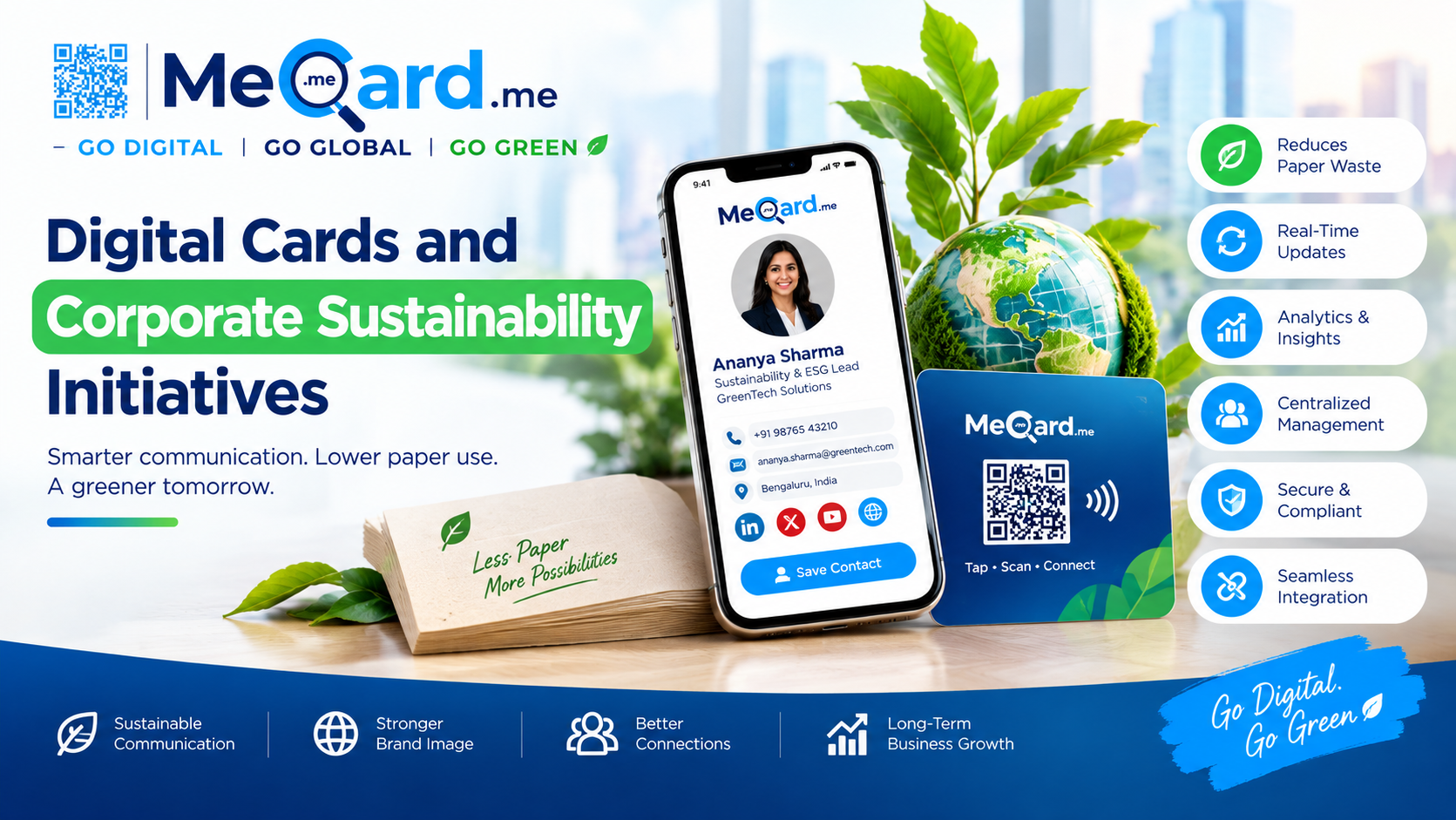
Corporate sustainability is no longer limited to large-scale environmental projects, renewable energy, or supply-chain transformation. Today, sustainability is increasingly influenced by the everyday operational choices an organization makes.
From reducing paper consumption to digitizing employee processes, companies are looking for practical ways to reduce waste while improving efficiency.
One such opportunity exists in something that appears surprisingly simple: the business card.
For decades, organizations have printed business cards for employees, executives, sales teams, consultants, event representatives, and business development teams. But as employee details change, companies rebrand, teams expand, and cards become outdated, the cycle of printing, replacing, distributing, and discarding continues.
Digital Cards offer a practical way to rethink this process.
With QR-based sharing, NFC connectivity, real-time updates, centralized administration, and digital identity capabilities, platforms such as MeCard can help organizations move professional communication toward a more sustainable and digitally connected model.
When businesses talk about sustainability, the conversation often focuses on carbon emissions, energy efficiency, responsible sourcing, waste management, and ESG reporting.
However, meaningful sustainability is also built through hundreds of smaller operational decisions.
Consider the number of physical cards used by a large organization.
A company may have hundreds or thousands of employees. Sales teams exchange cards with prospects. HR teams issue employee identification cards. Executives distribute cards during meetings. Marketing teams distribute cards at exhibitions and conferences. Branch teams may use cards across multiple locations.
Now consider what happens when information changes:
Instead of updating a digital profile, traditional organizations often have to print new materials.
The result is a recurring cycle:
Print → Distribute → Update → Reprint → Replace → Discard
Digital Cards can fundamentally change this cycle by allowing professional information to be updated digitally rather than requiring a new physical card every time information changes.
A single business card may contain only a small amount of paper. Individually, its environmental impact may appear insignificant.
The larger issue is scale.
Imagine an enterprise with 1,000 employees. If employees regularly receive new cards because of designation changes, rebranding, contact updates, events, or replacement requirements, the organization can create a continuous demand for printed materials.
The same principle applies to employee identification cards, membership cards, visitor passes, and other physical identity materials.
For sustainability-focused organizations, the question is therefore not simply:
"Can we recycle our cards?"
It is:
"Why are we repeatedly producing physical cards that can be digitally updated and managed?"
This is where digital transformation and sustainability intersect.
Digital Cards replace static physical information with connected digital identities.
Instead of handing someone a printed card, an employee can share a professional profile through a QR code, NFC interaction, link, WhatsApp, email, SMS, or other digital channels.
The recipient can access information such as:
More importantly, the information can remain dynamic.
If an employee changes their designation or contact information, the digital profile can be updated without producing another batch of physical cards.
MeCard's digital business card ecosystem supports QR and NFC sharing, real-time updates, digital profiles, analytics, and centralized enterprise management.
This makes the Digital Card more than an electronic version of a visiting card. It becomes part of an organization's broader digital identity infrastructure.
Going paperless is often discussed as a technology initiative. But it can also become a sustainability initiative.
A company replacing paper-based processes with digital alternatives can potentially reduce its dependence on physical materials across multiple workflows.
MeCard's platform extends beyond Digital Business Cards into employee IDs, visitor passes, membership cards, and other QR-enabled identity solutions.
This creates an interesting sustainability opportunity: instead of treating digital cards as an isolated networking tool, organizations can incorporate them into a broader paperless workplace strategy.
One of the biggest advantages of digital identity is that information does not have to remain permanently tied to a physical object.
Consider a sales executive whose designation changes from Sales Manager to Regional Business Head.
With a traditional card, the old cards may become outdated. With a Digital Card, the profile can be updated centrally.
The same applies to changes in:
This ability to update information digitally can help organizations reduce the frequency with which physical cards need to be replaced. MeCard highlights real-time profile updates as part of its digital card approach.
Employee lifecycle management presents another important opportunity.
Employees join organizations. They change roles. They move between departments. They transfer locations. They sometimes leave the organization.
With physical cards, these lifecycle events can create administrative work around issuing, replacing, collecting, and deactivating identity materials.
Digital identity platforms can provide a more flexible model.
A digital profile can be updated when an employee changes roles and deactivated when their organizational association ends.
This makes digital identity relevant not only to sustainability teams but also to HR, IT, administration, compliance, security, and operations.
For enterprises, sustainability becomes stronger when environmental objectives are connected to operational efficiency.
Environmental, Social and Governance initiatives increasingly require organizations to demonstrate how sustainability is integrated into business operations.
Digital Cards can contribute primarily to the environmental dimension by supporting paperless professional communication and reducing dependence on physical networking materials.
But their impact can extend further.
This does not mean that adopting Digital Cards alone makes an organization ESG-compliant or sustainable.
Instead, Digital Cards can become one practical component of a much larger sustainability strategy.
One reason sustainability initiatives sometimes struggle is the perception that environmental responsibility requires businesses to compromise convenience or productivity.
Digital Cards challenge that assumption.
Going digital can simultaneously improve professional networking and support sustainability objectives.
MeCard describes this combination through its positioning around digital, connected, and sustainable professional identity: "Go Digital. Go Global. Go Green."
Sustainability does not necessarily have to be an additional initiative sitting outside normal business operations. It can be embedded into the tools employees already use.
For organizations considering Digital Cards as part of a sustainability program, measurement is important.
Instead of simply saying that the company has "gone green," organizations can monitor operational indicators such as:
These metrics can help sustainability and operations teams understand whether digitization is actually changing organizational processes.
The objective should not be to create impressive sustainability messaging. It should be to create measurable operational change.
The modern enterprise is already moving toward digital workflows.
Contracts are digital. Payments are digital. Meetings are digital. Employee communication is digital. Customer interactions are increasingly digital. Identity is becoming digital.
Professional networking should not remain dependent on static printed information.
Digital Cards fit naturally into this transformation because they combine identity, communication, networking, and information management in one connected experience.
For enterprises, this creates a powerful opportunity.
A small change in how employees share their professional identity can become part of a larger movement toward paperless operations, smarter identity management, and more sustainable business communication.
MeCard is designed to help organizations move beyond individual digital business cards toward a broader digital identity ecosystem.
Organizations can use digital solutions for professional networking, employee identity, visitor management, membership experiences, and QR-enabled information sharing.
Its enterprise-oriented capabilities include centralized management, customized templates, real-time updates, analytics, QR/NFC functionality, and integrations designed to support organizational workflows.
For a sustainability-focused organization, the value is therefore not simply replacing a piece of paper.
It is creating a more connected system where professional information can be created once, managed centrally, updated instantly, and accessed digitally.
Corporate sustainability does not always require a massive transformation. Sometimes, it starts with questioning everyday processes.
Digital Cards provide one answer.
They can help organizations reduce their dependence on physical networking materials while creating a faster, more flexible, and more measurable professional identity experience.
For companies building sustainability strategies for the future, the opportunity is clear:
Reduce what needs to be printed. Digitize what can be updated. Manage what can be centralized. Measure what can be improved.
And make sustainability part of the way business happens every day.
Go Digital. Go Global. Go Green.
Digital Cards can reduce reliance on printed business cards by allowing employees to share professional information through QR codes, NFC, and digital links. They also allow information to be updated without reprinting cards whenever details change.
Yes. Digital Business Cards can reduce the need for printed networking materials, particularly when organizations adopt them across large employee populations. The actual reduction depends on adoption and how many physical cards are avoided.
Digital Cards allow professional details to be updated digitally. Enterprise platforms can also support centralized administration, consistent templates, and employee identity lifecycle management.
Digital Cards can support the environmental dimension of ESG by helping reduce dependence on printed materials. They may also support operational efficiency and identity governance. However, adopting Digital Cards alone does not establish ESG compliance.
Organizations can track metrics such as physical cards avoided, printing frequency, replacement requirements, employee adoption, and the number of paper-based processes replaced. Environmental claims should be based on documented results and an appropriate measurement methodology.
MeCard offers digital business cards, QR and NFC sharing, Digital IDs, centralized management, and digital identity capabilities that can help organizations reduce dependence on physical networking and identity materials.
Phone: +91 77770 01366 / +91 77770 01369
Email: contact@mecard.me
Website: www.mecard.me